

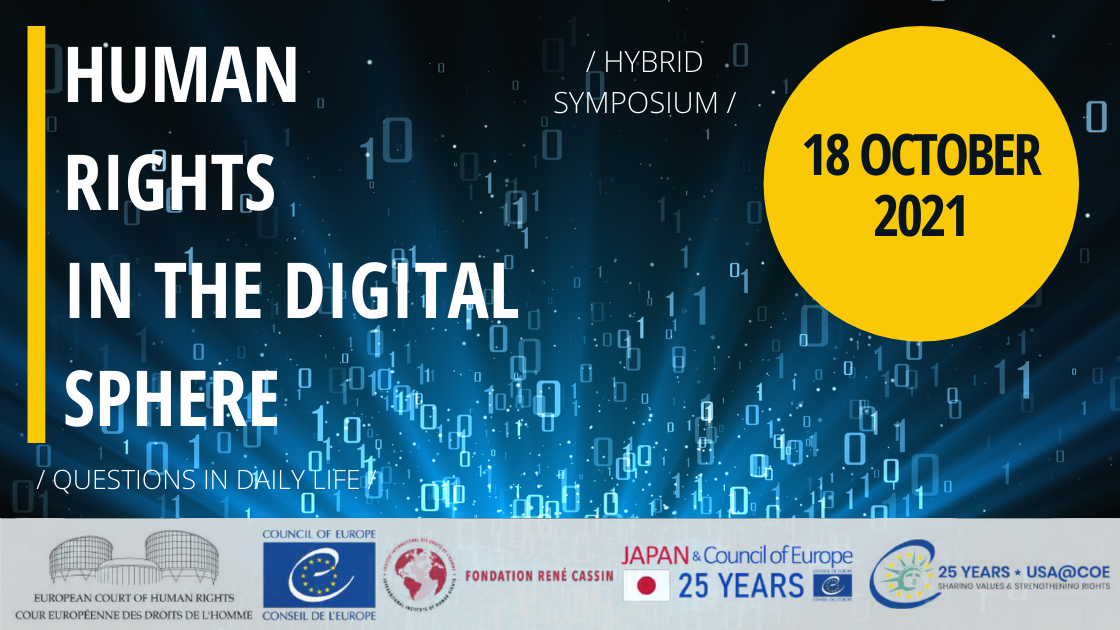
 On 18 October 2021, the European Court of Human Rights, in collaboration with Japan and US consulate generals in Strasbourg, the René Cassin Foundation and Directorate General of Human Rights and Rule of Law of the Council of Europe, are hosting a hybrid symposium on Human Rights in the Digital Sphere. The programme can be accessed here, and the registration is available via this link.
Here is a short summary of the event prepared by the organisers.
‘The digital transformation of our society is certainly one of
the fastest and most profound transitions of civilization we have ever
experienced. This digital age is leading us to interact more and more
online, for information, entertainment, consumption or work. The
Covid-19 pandemic revealed the potential of digital services which have
enabled people to continue to interact and engage and have made us more
resilient. But many questions remain about the consequences of this
transformation and its impact on human rights.
The issue of privacy has long been very topical in our daily lives,
but the increased use of the virtual space and the development of
technology such as AI, brings these debates even more into the
limelight. Rather than reducing discrimination or inequality, some
algorithmic decision-making systems can exacerbate it, particularly in
the public sphere. With the use of predictive features in the justice
system, even a new source of law seems to be emerging. Facial
recognition tools are bringing back concepts such as physiognomy and the
belief that behavioral traits can be inferred from physical
characteristics.
Other paramount issues which cannot be separated from internet are
freedom of expression and access to correct and trustworthy information.
Whereas the internet greatly facilitates ways to express ourselves and
the diversity of information available, it is also true that some
stakeholders have the power to ban, remove or distort online content
according to their interest. How should we draw the line between
information worth sharing and that to be banned? And who are those
entitled to do so?
Full enjoyment of our rights in cyberspace comes with an adequate
protection against the risks in an online environment. Right to private
life, human dignity, safety, integrity of the person, non-discrimination
are at stake under threat from cybercrime. How can the governments
fulfill their positive obligations to protect individuals against crime
and safeguard the fundamental rights of cybercrime victims? This
challenge requires careful balancing to provide efficient criminal
justice response with appropriate rule of law safeguards.
Speakers from different legal systems and jurisdictions, experts and
governmental representatives will exchange views, while tackling the
complexity of protecting human rights in the digital sphere in our daily
lives activities in a one day seminar.
The outcomes of the discussions build further on the current debate
on a global scale, about the actions necessary to include in a
comprehensive approach in order to address the radical changes
digitalization is brining to the online and offline environments.’