

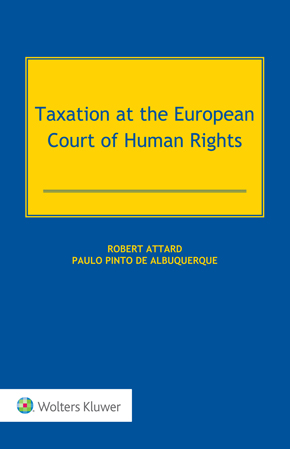

Robert Attard (EY and University of Malta) and former ECtHR judge Paulo Pinto de Albuquerque (the Catholic University of Portugal) have published a book entitled Taxation at the European Court of Human Rights. Here is an overview of the book:
Taxation at the European Court of Human Rights is
a first-of-its-kind to critically analyse over 500 of the European
Court of Human Rights (ECtHR’s) important ‘tax cases’, which create a
human rights code of conduct for European Convention on Human Rights
(ECHR) State Signatories in matters involving taxation. Albeit the ECHR
mentions taxation only once – and in a context that, rather than
conferring rights, limits their application – references to public
prerogatives pertinent to taxation are present in several of the ECHR’s
articles, giving rise to an implied normative framework that has
influenced the tax jurisprudence of the ECtHR. Especially given the
enormous impact of the famous Yukos cases, the ECtHR has made it
abundantly clear that tax policies of State Signatories must be
regularly stress-tested against the requirements of the Convention.
In
this book, relevant articles of the ECHR are each addressed by a
detailed analysis of successful and non-successful tax cases flowing
from it. The following invaluable knowledge base and guidance on the
ECHR’s relevance to taxation have been furnished:
- the ECHR’s legal concept ‘margin of appreciation’ and the ECtHR’s supervisory jurisdiction in taxation matters;
- the legal avenues to impugn tax measures based on Article 1 of Protocol 1 ECHR and other articles of the ECHR;
- the lines of defence hampering judicial activism in the tax arena;
- the concept of ‘emergency’ in tax policy;
- the effects of tax penalty classification and retrospectivity;
- the right to a fair trial in tax disputes; and
- the extent tax policy may hamper the right to privacy and other fundamental human rights.
In
elaborating on the nexus between taxation and human rights, this book
proves to be a vital contribution to a crucial element of the ongoing
debate focusing on the tax-related jurisprudence of the ECtHR. With its
practice-oriented tax policy rulebook drawn from the judgments of the
ECtHR, tax practitioners and in-house counsel will approach any case
with cognisance of its human rights implications and constitutional
consequences.